
Leaking & Failed Tile Shower Repair in Evanston, Illinois
A tile shower can look recently renovated and still develop a crack that repeatedly returns. An older shower can show one wet joint while the larger assembly remains stable. Water may appear at a baseboard, ceiling, or threshold after traveling away from its entry point. The surface identifies where the problem became visible; it does not automatically identify the failed layer or the proper scope.
North Shore Tile & Shower Repair begins with that distinction. Owner Kristopher Duschen reviews the symptom sequence, previous repair attempts, visible transitions, and accessible conditions before recommending work. His goal is to find a defensible boundary: preserve stable tile, stone, and glass when the repair can connect to sound construction, and expand the opening when concealed failure continues beyond the first visible defect.
Explore 4NST's tile and shower repair services or request an owner-led shower inspection.
Call 847-446-2029 about an Evanston tile shower with recurring cracks, loose material, unexplained moisture, or trouble after an earlier renovation.
Quick Answer: How Do You Decide Whether an Evanston Shower Needs Repair or Reconstruction?
The decision depends on where the failure ends. A focused repair can be responsible when the defective area is accessible, the surrounding assembly is stable, and new support and waterproofing can join sound existing construction. Reconstruction becomes necessary when movement, deterioration, poor drainage geometry, or discontinuous waterproofing extends beyond a reliable local boundary. The age of the residence and the appearance of the tile provide context, but neither decides the scope alone.
Start With a Symptom Map, Not a Product List
Before choosing grout, sealant, membrane, or replacement tile, map what the shower is doing. The most useful observations connect location with timing:
- Where the evidence begins — Mark the first crack, loose piece, dark joint, damp threshold, stain, or sound of movement.
- When it appears — Note whether the symptom begins immediately, after several minutes of use, later in the day, or while the shower is not operating.
- What changes it — Record whether spray direction, door position, use of a bench, or pressure near a loose area changes the event.
- What was tried — List regrouting, recaulking, sealing, tile replacement, glass adjustment, or plumbing work and how long any improvement lasted.
- Where the effect travels — Photograph changes outside the enclosure, in an adjacent room, or below the bathroom without assuming that location is the source.
This record helps separate a finish-maintenance issue from movement, failed bond, an enclosure transition, a drain relationship, or a broader wet-area assembly problem.
Older and Newer Construction Can Meet Inside One Bathroom
Evanston includes older residences, renovated homes, and condominiums. That mix is useful diagnostic context, not a diagnosis and not a claim about any particular property. A shower may have been rebuilt while portions of the floor structure, wall framing, plumbing route, or surrounding finish remained. A condominium bathroom may have several renovation chapters even when the visible tile belongs to only the latest one.
Connections between those chapters deserve attention. A newer backer may end at older framing; a changed shower footprint may cross a floor transition; a replacement curb or pan may meet wall work from another phase. None of those conditions proves faulty installation. They explain why the construction and renovation history can help locate the places where movement or water containment should be evaluated.
Identify Which System Owns the Symptom
Similar-looking moisture can originate from different systems. Good diagnosis keeps them separate long enough to follow the evidence.
Tile-shower assembly: Cracked mosaics, loose tile, a dark curb, failed wall-to-floor transitions, drain-area movement, and moisture tied to shower use can indicate a problem within the support, bond, waterproofing, or containment details.
Glass and enclosure transitions: Water that responds immediately to spray direction or appears at a door, sweep, jamb, or hardware penetration may follow an enclosure route. That condition can exist by itself or alongside an assembly failure.
Plumbing and drainage: Moisture when the shower is unused, an active pressurized leak, a blocked drain, or a drain-line problem belongs with a licensed plumber or appropriate drain professional. Those conditions should not be mislabeled as tile or pan failures.
4NST's specialty is the tiled wet-area assembly and the construction that supports and waterproofs it. When the evidence points outside that scope, identifying the correct trade is part of avoiding unnecessary shower demolition.
A Recurring Crack Is Evidence of Continuing Behavior
Fresh grout can make a crack disappear without changing the reason it formed. If the same line returns, it is recording continued stress or movement somewhere in the assembly.
A straight route may correspond to a substrate seam or change in support. A crack that crosses tile rather than following only a joint raises a different bond or movement question. Damage around the drain, curb, bench, or wall base directs attention to those transitions. Clicking, flexing, rocking, hollow sounds, or neighboring pieces losing bond add physical evidence that the problem is not limited to the grout itself.
The pattern does not establish the hidden condition from a photograph. It helps Kristopher decide whether surface maintenance remains plausible, whether a controlled opening is warranted, and where that opening can answer the most useful question.
Why an Earlier Renovation Can Fail Without Looking Worn Out
Visible finish quality does not verify what lies below it. A recently installed shower can have inadequate mortar contact, moving support, a poorly resolved material transition, improper pitch, or a discontinuity in waterproofing. Conversely, the mere fact that a bathroom is older does not mean its entire shower must be discarded.
Renovation history matters because it creates a timeline. If a crack appeared soon after completion, reopened after a tile was replaced, and now darkens after use, each step narrows the investigation. If a leak began only after glass or plumbing work, that change belongs in the record too. The recommendation should follow the present evidence rather than blame the newest or oldest component by default.
What Makes a Focused Repair Credible?
A selective repair needs more than a small visible defect. It needs a stable technical endpoint. The surrounding tile and substrate must remain firm; the defective construction must be reachable; the new waterproofing must connect dependably; and the drain, slope, curb, or adjoining plane must still function or be correctable inside the opening.
A credible limited scope might involve a defined floor zone, curb, threshold, bench connection, wall base, drain transition, or group of loose pieces. The exact boundary is discovered through inspection and, when needed, a deliberate opening. “Focused” means the defect can be isolated and corrected—not that the least possible material will be removed regardless of findings.
When the Scope Has to Expand
Broader reconstruction becomes appropriate when the assembly does not offer a trustworthy stopping point. Warning conditions include movement across multiple planes, widespread hollow or loose tile, soft or deteriorated support, moisture damage continuing past the proposed edge, inadequate pitch that cannot be corrected locally, or waterproofing that cannot be tied together inside a small opening.
Repeated repairs matter as well. If grout, caulk, or individual tile replacement has failed several times because the same concealed weakness remains, repeating the same boundary is not preservation. The opening should continue until dependable construction is reached. That can require more than a floor patch without automatically requiring a complete bathroom remodel.
Preserve Sound Finishes Without Preserving the Failure
Original tile, natural stone, custom glass, and surrounding bathroom finishes may have design or replacement value. They should remain when they are stable, outside the failed zone, and compatible with reliable new work. They may require protection or careful temporary removal to create access.
Preservation has limits. A finish that conceals deterioration, cannot be separated safely, or prevents a continuous waterproofing connection may need to be replaced. Discontinued tile and variation in natural stone also make an invisible match uncertain. Spare material, salvage, or a deliberate complementary transition may be more realistic than promising that a repaired area will disappear.
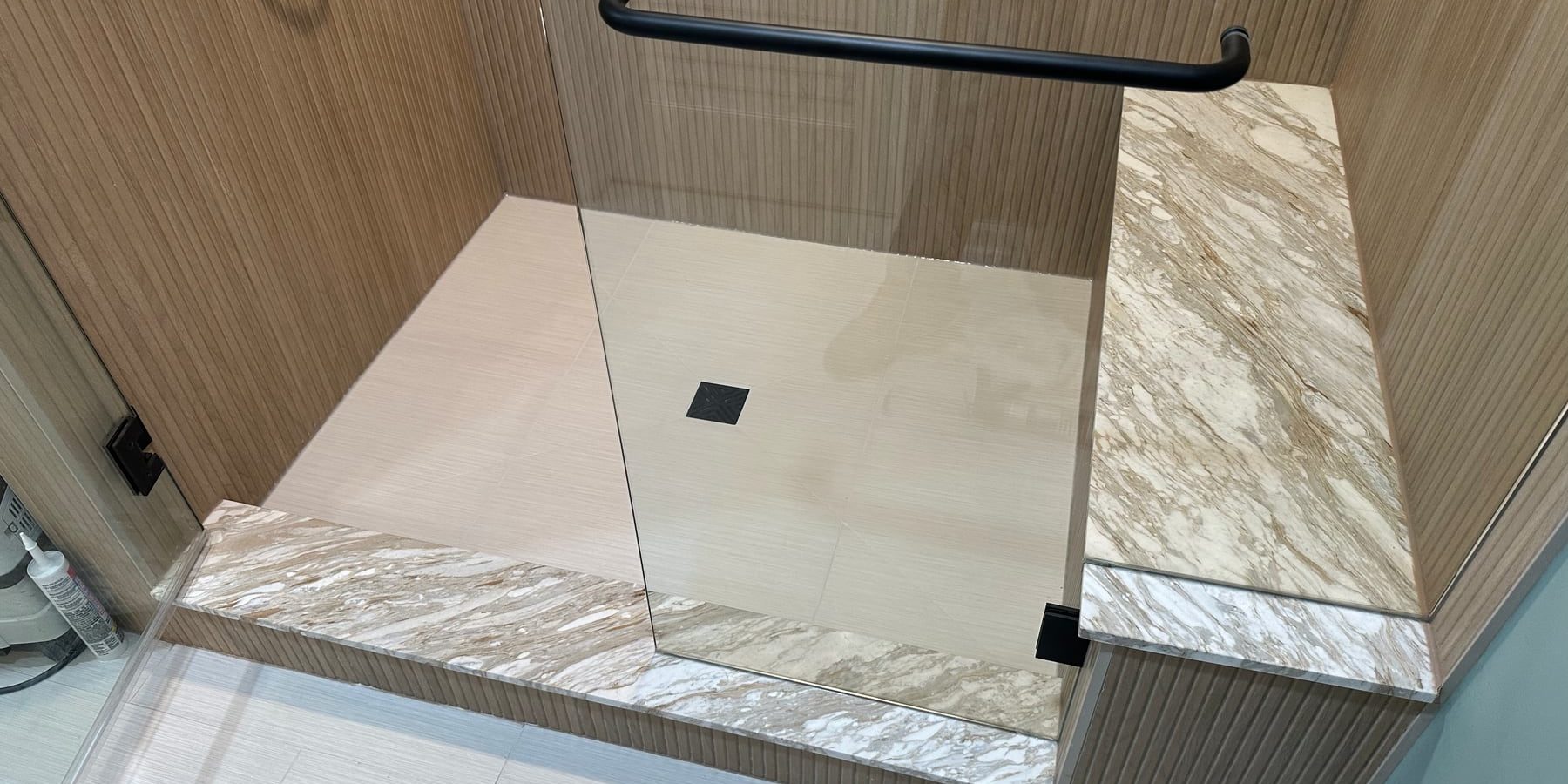
Documented Regional Proof, Clearly Located in Highland Park
The related project shown on this page is in Highland Park—not Evanston. Its penny-round shower floor carried extensive cracking. Removal revealed that the substrate had been structurally compromised by improper installation. 4NST rebuilt the failed floor while retaining the surrounding wall tile, stone surfaces, and glass enclosure.
The case demonstrates the decision standard described here: identify the failed layer, remove enough to reach a sound boundary, and preserve adjacent finishes only when the corrected assembly can support them.
See the complete Highland Park failed shower-floor case study.
Is This an Appropriate 4NST Inquiry?
A good-fit inquiry usually concerns the tiled shower assembly: a crack that keeps returning, tile that rocks or clicks, a floor that has lost bond, a curb or threshold that stays damp, water connected to shower use, a suspect pan-to-drain relationship, or a prior localized repair that did not last. A failed renovation can also be a fit when the question is which shower components can responsibly remain.
Routine cleaning, cosmetic grout-color changes, a simple drain blockage, or a supply-pipe repair may belong with another service. Photographs can help qualify the concern, but they do not prove the cause or final repair boundary.
Send a Useful Evanston Shower History
Begin with one wide photograph showing the complete shower and enclosure. Add close views of the crack, floor, drain, curb, threshold, wall base, and any effect outside the enclosure. Then include a short timeline: when the shower was installed or renovated if known, when the symptom started, how use affects it, and what previous grout, caulk, tile, glass, plumbing, or sealing work changed.
Mention any clicking, flexing, hollow sound, recurring line, or spare matching material. Identify the tile, stone, or glass you most hope to retain. Leave the assembly undisturbed before the initial conversation; removing a piece can erase clues and cause damage before the boundary is understood.
The Owner Who Diagnoses the Shower Stays Involved
4NST is owner-operated. Kristopher leads the evaluation and remains directly involved through the tile-shower repair rather than transferring the job from a salesperson to a subcontracted tile crew. That continuity matters when concealed conditions require the plan to be reconsidered after an opening.
North Shore Tile & Shower Repair has served Chicago and the North Shore since 1982. Read about the owner-operated company and browse the 4NST project gallery.
Evanston Is a Service Area, Not a Second Business Location
The company operates from Morton Grove and serves Evanston as part of its Chicago and North Shore territory. This page does not create or imply an Evanston office. Review the complete Chicago and North Shore service area.
Frequently Asked Questions
What should be investigated when an Evanston shower leak keeps returning?
The investigation should compare where the water becomes visible with when it appears, how spray direction changes it, and what earlier repairs affected it. The entry point may be at a curb, drain, wall transition, enclosure detail, or another location along the path. Repeated surface treatment should not substitute for identifying the system that is releasing water.
Does a recurring shower-floor crack mean the whole shower must be rebuilt?
No. A recurring crack shows that the underlying behavior has not been resolved, but its extent still has to be established. If the affected construction can be removed, new work can join a stable waterproofed assembly, and nearby surfaces remain sound, a focused repair may be possible. Continued movement or deterioration requires a wider scope.
How can an older home or renovated condominium affect the shower diagnosis?
Different construction phases may meet inside the same bathroom. The visible shower, floor support, wall framing, plumbing transitions, or surrounding finishes may not have been installed together. That history helps identify junctions to examine, but the condition found in the assembly—not the property category or age—determines the recommendation.
Can sound tile, natural stone, or shower glass remain during a repair?
Sometimes. Finishes outside the failed zone may remain when they are stable, can be protected or removed safely, and do not prevent dependable access and waterproofing. Concealed damage, material fragility, glass-handling requirements, and the availability of matching tile can change the preservation plan after work begins.
What is the difference between a focused repair and a shower reconstruction?
A focused repair removes a defined failure and ends at verified stable construction where support, drainage, and waterproofing can be restored reliably. Reconstruction is needed when the defect crosses that boundary, affects several connected components, or leaves no dependable place to join new work. Neither term automatically means remodeling the entire bathroom.
What should I send before requesting an Evanston shower inspection?
Send a full-shower photograph, close views of each crack or wet area, images of the drain, curb and threshold, and any damage outside the enclosure. Include the renovation date if known, symptom timing, earlier repair attempts, movement or hollow sounds, materials you want to retain, and whether spare matching tile is available.
Request an Owner-Led Evanston Shower Inspection
Describe what the shower does, when it happens, what work came before it, and which finishes matter most. That sequence gives Kristopher a stronger starting point than a product request or one isolated close-up.
Call 847-446-2029 or request a professional shower inspection.
Morton Grove-based 4NST serves Evanston, Chicago, and the North Shore.