
Leaking & Failed Tile Shower Repair in Northfield, Illinois
Water appearing outside a Northfield tile shower is evidence of a route, not automatic proof that the nearest grout or caulk joint caused the leak. The source may involve door or glass containment, a curb or lower-wall transition, the shower floor and drain connection, a penetration, movement in the supporting assembly, or a plumbing condition. The wet spot shows where water became visible; it may not show where the path began.
North Shore Tile & Shower Repair is owner-operated. Kristopher Duschen reviews when the symptom appears, what becomes wet first, whether anything moves, what previous repairs changed, and which finishes cross the suspected failure boundary. That diagnosis guides whether a focused repair is credible or a connected portion of the shower needs broader reconstruction.
Review 4NST's tile and shower repair services or send photographs and the symptom timeline for an owner-led inspection.
Quick Answer: Is Water at the Shower Curb Always a Caulk Problem?
No. A separated joint at a curb can be a maintenance issue, but water at the curb can also escape from the door or glass system, travel through a failed change of plane, migrate from the shower floor, follow a penetration, or originate from plumbing. Replacing caulk is appropriate only when the joint itself is the bounded problem. If the opening returns, tile moves, or water continues after the surface treatment, the connected assembly deserves evaluation.
The useful question is not simply, “Where is the wet spot?” It is, “What sequence of use, movement, and construction details could deliver water to that spot?”
Record the Sequence Before the Surface Dries
A short symptom timeline helps separate competing causes without destructive guessing. During normal use, note the following without intentionally flooding the shower or repeating a test that is damaging another finished space.
- Before use: Is every visible area dry, or does moisture appear while the shower is idle?
- First activation: Does water appear immediately when spray reaches the door, curb, bench, wall, or fixture area?
- Extended use: Does the symptom begin only after several minutes, suggesting accumulation or migration?
- After shutoff: Does water continue to appear after the shower stops, and for how long?
- Next day: Do joints stay dark, does an odor remain, or does a nearby finish dry unusually slowly?
Photograph the first visible water, not only the largest stain. Time and sequence can be more diagnostic than the final size of the wet area.
Four Systems Can Deliver Water to the Same Location
Door and glass containment
Sweeps, seals, jambs, channels, hardware penetrations, spray direction, and the relationship between the glass and curb can allow water to escape even when the buried shower assembly remains sound. A containment route should be considered rather than assuming every curb-side symptom requires tile removal.
Plumbing and drainage
Supply piping, valves, fixtures, traps, and drainage conditions may require a licensed plumber or another appropriate professional. Moisture that appears while the shower is idle, follows fixture operation, or does not depend on wetting the tiled surface changes the order of investigation. 4NST does not present tile repair as a cure for a plumbing defect.
Surface joints and finish materials
Grout, flexible sealant, and suitable sealer have legitimate but limited functions. They can correct an isolated joint or help an appropriate finish resist absorption and staining. They cannot add support beneath moving tile, create proper slope, rebuild a failed curb, reconnect waterproofing, or correct a defective drain interface.
The tiled wet-area assembly
The floor, substrate, bond, slope, waterproofing, drain interface, curb, bench, lower walls, penetrations, and changes of plane must work as a connected water-management system. Recurring cracks, loose tile, deflection, hollow changes in sound, or moisture at more than one boundary can indicate that the visible joint is part of a larger failure path.
Follow the Connected Path, Not the Nearest Crack
A crack beside a wet area deserves attention, but proximity alone does not prove origin. Water can enter at one point, move along a waterproofing layer or construction joint, and exit where resistance is lowest. Conversely, an enclosure leak can wet the curb and bathroom floor without any buried waterproofing failure.
Kristopher compares several relationships:
- whether the crack changes when pressure is applied nearby;
- whether the line continues across tile pieces, grout joints, planes, or material transitions;
- whether moisture follows the same activation pattern every time;
- whether a prior repair moved, reduced, or delayed the symptom;
- whether the floor, curb, bench, or lower wall behaves as one connected area; and
- whether the drain, glass, fixture, or plumbing route remains a competing explanation.
This prevents a convenient visible defect from becoming the diagnosis before the rest of the evidence is considered.
Why Recaulking Can Move a Leak Without Solving It
Fresh caulk can stop an isolated surface-joint leak. It can also close one exit while water remains inside the same route and appears somewhere else. A temporary improvement is useful evidence, but it is not proof that the concealed assembly is sound.
Record exactly what happened after the work:
- Did the leak stop completely, return after a delay, or move to another location?
- Did the joint reopen or separate from one side?
- Did tile movement remain even though the joint looked better?
- Did darkening or odor continue without visible water?
The response to a previous repair helps define the next inspection. Do not remove recent material only to make the shower look “original” before Kristopher reviews the photographs.
Transition-Heavy Showers Need a Boundary Plan
When a shower includes a bench, niche, stone cap, threshold, frameless glass, multiple wall planes, or several penetrations, each transition adds a relationship that may need to be examined. This does not mean the entire shower is defective. It means a responsible repair cannot end at a convenient cosmetic line if support or waterproofing failure continues past it.
Before recommending a scope, the evaluation should answer:
- Which component most likely begins or controls the water path?
- Does movement or deterioration extend beyond the visible symptom?
- Where can new support and waterproofing connect to material that is demonstrably stable?
- What must be removed or protected to reach that connection?
- Will preserving a finish interfere with a dependable repair termination?
A responsible boundary is the smallest one that can be technically reliable, not automatically the smallest opening that can be made.
When a Focused Repair May Be Credible
A focused repair becomes more credible when the evidence points to a bounded condition, surrounding material is stable, access is workable, and the new support and waterproofing can terminate reliably. Depending on the diagnosis, a repair might involve a curb or threshold area, a drain field, a lower perimeter, a floor section, or an isolated enclosure transition.
The scope still has to account for slope, drainage, fastening or bond, movement accommodation, and the connection to what remains. “Small” describes the area, not the technical standard.
When the Connected Scope May Need to Expand
Broader reconstruction may be the more responsible recommendation when:
- cracks or loose material cross several connected components;
- the floor, curb, bench, or lower wall moves beyond one isolated spot;
- moisture appears at multiple boundaries or continues after an isolated repair;
- concealed deterioration extends beyond the proposed opening;
- slope, support, waterproofing, and drain-interface defects overlap; or
- there is no sound termination for new waterproofing within the proposed area.
The decision should follow the failure, not a preset preference for patching or remodeling.
Preserve Sound Finishes Without Preserving the Failure
Stone caps, wall tile, glass panels, hardware, trim, bathroom flooring, cabinetry, and matching material may influence access and sequencing. Photograph these elements before work and identify which ones physically cross the suspected boundary.
Preservation is possible only when the retained material is stable and does not block the new support or waterproofing connection. Some items may remain untouched; others may need careful removal for access; and material that is part of the failed connection may need replacement even when its exposed face looks sound.
That distinction protects valuable finishes without asking the repair to terminate against an unreliable assembly.
Documented Regional Proof, Accurately Located in Highland Park
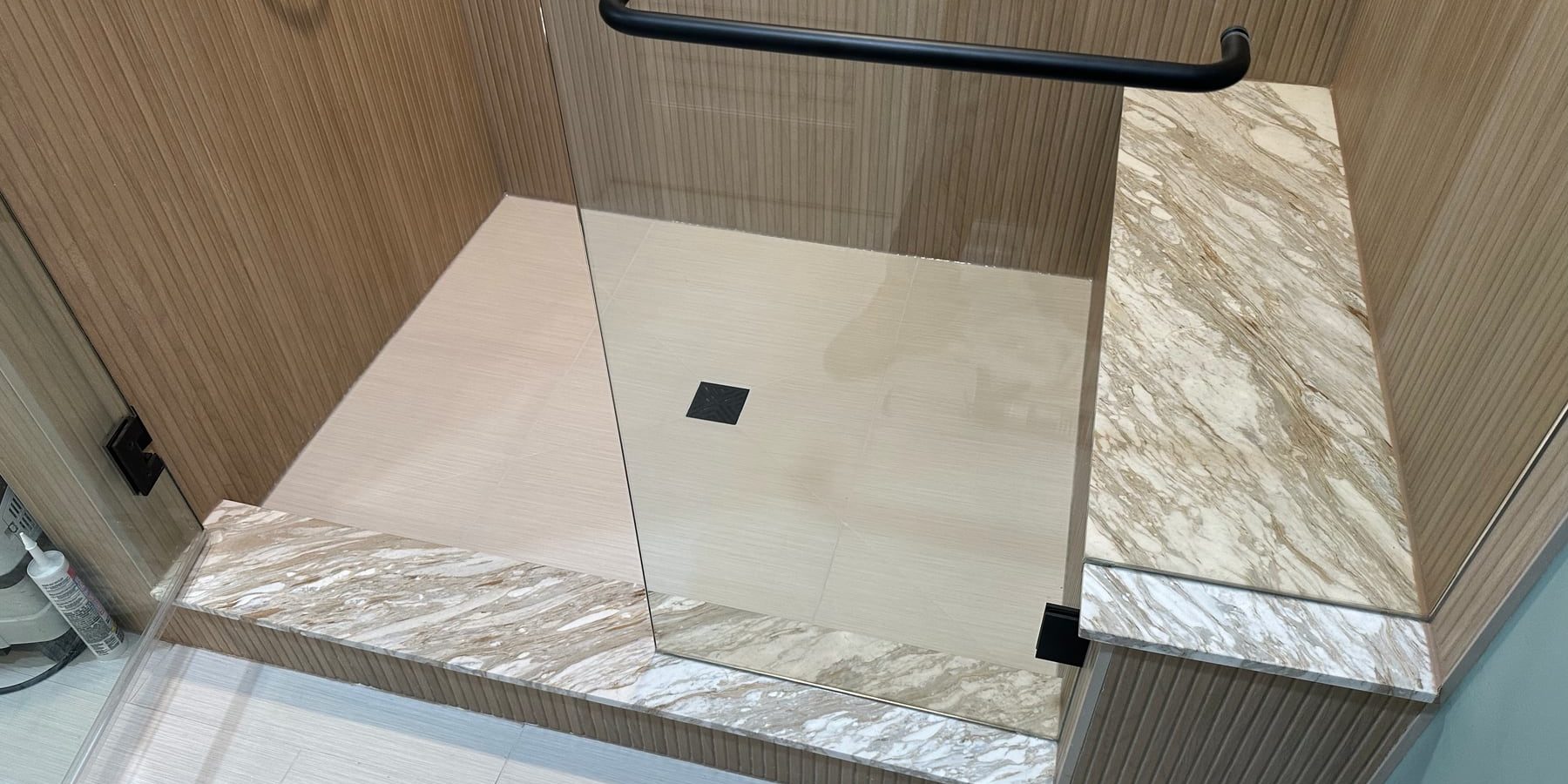
A documented 4NST project in Highland Park shows why a cracked shower floor may require investigation beneath the finish. Cracking crossed the penny-round floor, and removal confirmed that the substrate had been structurally compromised. 4NST rebuilt the failed floor while preserving the surrounding wall tile, stone surfaces, and glass enclosure.
That project is in Highland Park, not Northfield. It is included as regional proof of the method: follow the evidence below the visible crack, establish a dependable repair boundary, and preserve sound adjacent finishes when the new assembly can connect reliably.
See the complete Highland Park failed shower-floor case study.
Prepare a Useful Northfield Shower Brief
Before contacting 4NST, collect:
- one wide photograph of the entire shower and enclosure;
- close photographs of the floor, drain, curb, door or glass line, lower corners, bench, niche, fixtures, and visible damage;
- a photograph of the first place water appears outside the shower;
- the timing of the symptom during use, after shutoff, and while idle;
- any location that clicks, deflects, sounds hollow, or repeatedly opens;
- prior grout, caulk, sealer, glass, plumbing, or tile work and what changed afterward;
- finishes you hope to preserve and any matching material available; and
- whether water is reaching another room, a finished ceiling, or electrical components.
If active water is reaching another finished space, stop using the shower rather than repeating the test. If moisture appears independently of shower use or suggests a pressurized plumbing source, contact a licensed plumber or the appropriate professional.
Owner-Operated Diagnosis and Direct Involvement
4NST has served Chicago and the North Shore since 1982. Kristopher hears the symptom history, evaluates the tiled assembly, explains the proposed boundary, and remains directly involved when North Shore Tile & Shower Repair performs the work. Tile-shower repair is not sold by one person and handed to a subcontracted repair crew.
That continuity matters when the scope is conditional. The same owner can explain why a surface treatment is or is not appropriate, which retained finish affects access, what an opening needs to confirm, and why the plan changes if concealed conditions cross the expected boundary.
Learn more about the owner-operated company, review the documented 4NST project gallery, or see the current Chicago and North Shore service territory. Nearby completed resources include Northbrook shower repair and Wilmette shower repair.
Frequently Asked Questions
Why is water appearing outside my Northfield tile shower?
Water can escape through a door or glass detail, travel through a curb or lower-wall transition, migrate from the shower floor or drain area, follow a penetration, or originate from plumbing. The visible wet spot identifies an exit, not necessarily the source. Timing, spray location, movement, prior repairs, and the condition of connected components help narrow the route.
Will new caulk at the curb stop a tile-shower leak?
It may stop an isolated surface-joint leak, but it will not correct movement, insufficient support, improper slope, a failed waterproofing connection, or a defective drain interface. If the joint reopens, the leak moves, or moisture continues, the result of the caulk repair becomes evidence that the connected assembly needs evaluation.
Can a shower curb or floor be repaired without removing all the wall tile and glass?
Sometimes. A focused repair is possible when the failure is bounded, access is workable, surrounding material is stable, and new support and waterproofing can connect reliably to what remains. Tile, stone, or glass may need removal when it crosses the failed connection or blocks the only dependable repair boundary.
How does 4NST determine whether a shower failure is isolated?
Kristopher compares the symptom timing, crack and moisture pattern, tile movement, prior-repair history, slope, drain and curb relationships, and the stability of nearby material. A controlled opening may be recommended when surface evidence cannot confirm where deterioration stops or where new waterproofing can terminate.
When should a plumber inspect a shower leak before tile repair?
Contact a licensed plumber or the appropriate professional when moisture appears while the shower is idle, a pressurized supply or fixture is suspected, or the problem involves a trap, blockage, or plumbing drainage. Symptoms activated by wetting the tiled floor, curb, bench, lower wall, or enclosure fit a tile-assembly evaluation, although some problems require both disciplines.
Will Kristopher personally evaluate my Northfield shower?
Yes. Kristopher Duschen is the owner and lead specialist. He reviews the symptom history, evaluates the repair boundary, explains the recommendation, and remains directly involved when North Shore Tile & Shower Repair performs the work. The repair is not transferred to a subcontracted tile crew after the initial conversation.
Start With the Water Path, Not Another Guess
If water is escaping at a curb, door, bench, lower wall, or adjacent floor, preserve the evidence and record the sequence before applying another surface treatment.
Call 847-446-2029 or send photographs and request an owner-led shower inspection. Include when the water appears, where it first becomes visible, what has already been tried, whether anything moves, and which finishes matter most.
4NST is based in Morton Grove and serves Northfield, Chicago, and the North Shore.