
Leaking & Failed Tile Shower Repair in Bucktown, Chicago
A Bucktown bathroom may combine an older building shell, a later addition or conversion, and a shower installed during a much newer renovation. The polished tile belongs to the most visible chapter. Framing, subfloor, backer, drain and waterproofing can belong to different ones. When a crack returns after the remodel or the curb becomes wet, the useful question is not simply “How old is the shower?” It is “Which layer is moving or releasing water?”
That is where North Shore Tile & Shower Repair begins. Owner Kristopher Duschen traces the reported symptom, studies the renovation history that is available, and stays involved through the tile-shower work. A limited repair is considered only when it can end at a sound technical boundary. Stable finishes are retained when doing so does not compromise the correction.
Explore 4NST’s tile and shower repair services, or request an owner-led shower inspection and include photographs of the crack, curb, floor and any damage beyond the enclosure.
Quick Answer: What Does a Crack That Returns After a Remodel Suggest?
It suggests that the new grout or tile may be recording a condition beneath it. The driver might be flexing support, incomplete mortar contact, stress at a material junction, or deterioration associated with moisture. A repeated line is not enough to identify which condition exists, but it is a reason to stop treating the joint as an isolated cosmetic defect. Its route across the floor, relationship to the drain or curb, and recurrence after earlier work provide the more useful clues.
One Shower Can Contain Several Construction Eras
Mixed vintage and newer construction changes the diagnostic conversation. A bathroom may have been rebuilt without replacing every supporting component; a shower may sit where room dimensions or floor levels were altered; a condominium conversion may join newer wet-area materials to an older structure. None of those circumstances proves defective work. Each makes the connection between layers worth understanding.
Build a simple failure history before choosing a remedy:
- Renovation chapter — Record when the bathroom and shower were changed, whether the footprint moved, and whether any portion of the former assembly remained.
- First visible change — Note the original crack, hollow sound, curb discoloration, loose piece or water mark before later repairs altered it.
- Attempted correction — Identify what was regrouted, recaulked, sealed, replaced or adjusted and how long the improvement lasted.
- Current pattern — Mark whether the symptom follows a straight seam, circles the drain, tracks along the curb or appears elsewhere after use.
- Physical response — Report clicking, flexing, softness or a joint that opens and closes under ordinary pressure.
This timeline helps separate a worn finish joint from a shower whose hidden layers are no longer acting as one assembly.
Three Post-Renovation Patterns That Deserve Different Responses
1. A straight crack that reopens
A nearly straight fracture through mosaics or grout often acts like a map. It may align with a board joint, framing change, patch edge or other point where support differs from one side to the other. Replacing the material in that line will not eliminate motion below it. Before proposing a scope, Kristopher looks at where the line starts and stops, whether adjacent pieces have lost bond, and whether the floor responds under load.
2. A curb that darkens, separates or sheds water
The curb concentrates several connections in a narrow area: shower-floor waterproofing, curb top, jambs, enclosure hardware and the bathroom-side finish. Moisture on its outer face could begin at any of those interfaces. A wet curb is therefore not automatic proof that every part of the pan must be demolished; neither is it a reason to cover the joint with another bead of sealant without investigating the route.
3. A symptom beyond the enclosure
A baseboard change, doorway stain or mark below a condominium bathroom shows that moisture escaped containment. It does not name the entry point. The path may run along a fastener, backing surface, framing member, pipe or floor junction before it reaches the location that can be seen. Note whether the mark forms only when the shower operates, how much use precedes it, and whether aiming spray away from the door or curb changes the result.
These patterns can occur together, yet they should not be collapsed into one assumption. Floor movement may be separate from an enclosure leak; a damp threshold may be connected to the pan; a plumbing condition may imitate a tile-assembly failure. A pressurized leak, drainage blockage or symptom occurring independently of shower use belongs with a licensed plumber or appropriate drain professional. 4NST’s scope centers on the tile assembly and the construction that supports and waterproofs it.
“Pan Failure” Is Not Shorthand for Every Leak
The shower pan is one possible failure zone, not a universal explanation. A responsible diagnosis keeps the floor field, drain connection, curb wrapping, wall returns, penetrations and glass interfaces separate long enough to find the useful evidence.
For example, a door-side puddle that forms immediately calls for different questions than a crack that slowly darkens after ten minutes. A curb cap that rocks changes the analysis again. The term “pan leak” should follow findings, not replace them.
A Controlled Opening Can Answer What the Surface Cannot
Some showers provide enough surface evidence to rule out a simple maintenance repair, but not enough to define the entire correction. Opening a deliberate, limited location can reveal whether tile coverage is adequate, whether the base is firm, how moisture has affected the layers, and whether an existing waterproofing edge can accept new work.
The opening is useful only when it can change the decision. Kristopher looks for an access point that protects as much finished material as practical while exposing the suspected transition. Findings may support a narrow repair, show that the defect continues farther, or demonstrate that a nearby component cannot responsibly be left in service.
Keep, Open or Rebuild: Three Separate Decisions
Keep materials that are well bonded, outside the failed zone and compatible with a trustworthy connection. A sound wall, stone cap or section of enclosure may survive the work when access and protection allow.
Open enough of the assembly to remove the defective construction and create a stable endpoint. Stopping simply because the next tile is expensive can leave the original weakness beside the repair.
Rebuild the connected portion when its support, waterproofing or geometry cannot be corrected locally. This could mean more than a floor patch, but it does not automatically mean renovating the entire bathroom.
Material decisions follow the same logic. Existing tile can be salvaged only if removal is practical; natural stone varies; glass may need specialized handling; an unavailable match may call for a deliberate complementary border rather than a misleading promise. The repair should make technical and visual sense after the concealed condition is known.
Regional Proof, Clearly Identified: Highland Park Shower-Floor Recovery
4NST has documented a Highland Park shower whose penny-round floor carried extensive cracking. After removal exposed a structurally compromised substrate, the failed floor was reconstructed while the wall tile, stone surfaces and glass enclosure were retained.
That installation is in Highland Park—not Bucktown. It appears here solely as verified evidence of how a floor failure can be isolated and surrounding finishes can sometimes remain.
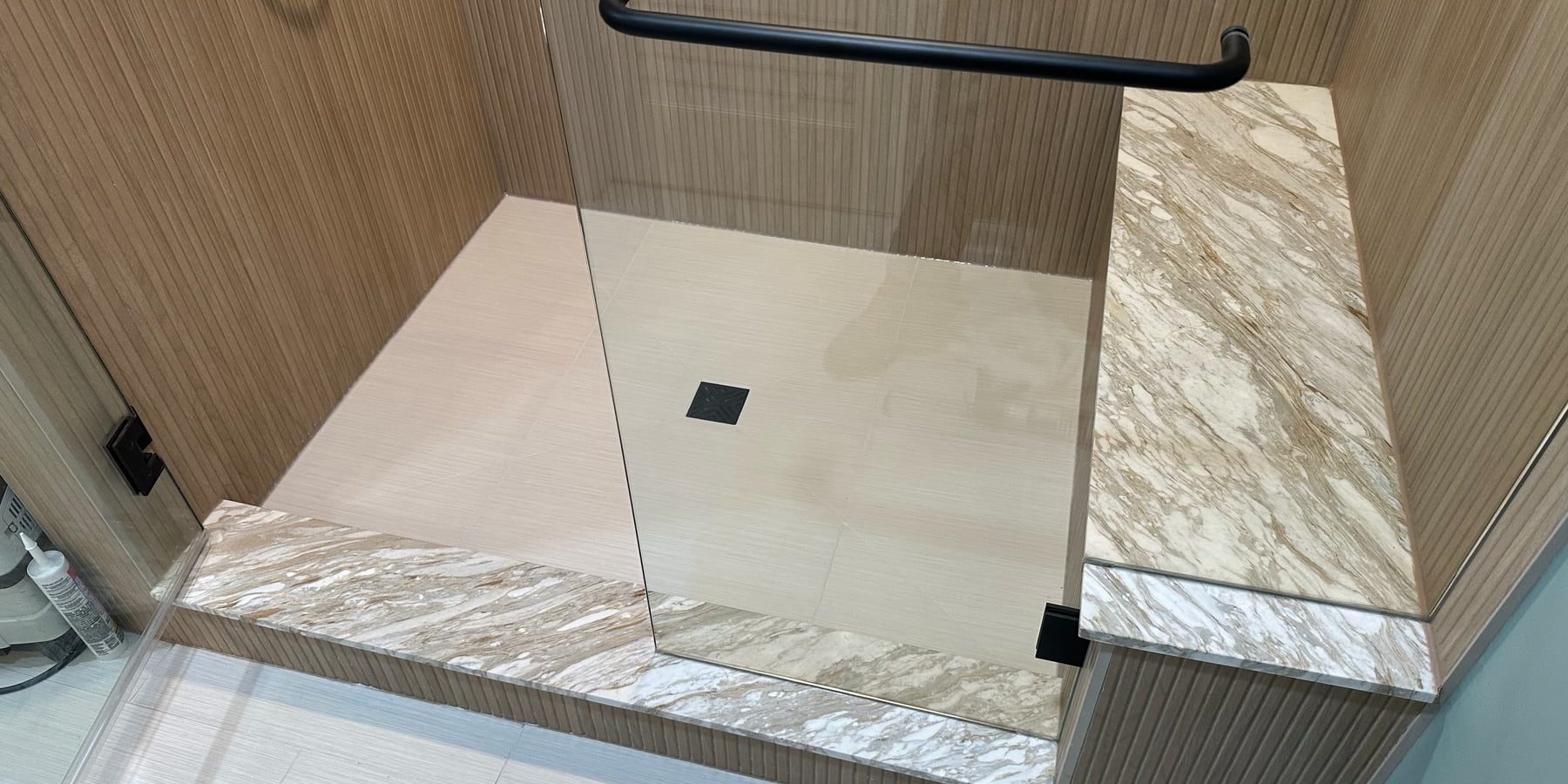
See the complete Highland Park failed shower-floor case study.
Where a Narrow Repair Earns Its Place
A smaller scope is credible when the defect can be reached, its outer edge is demonstrably stable, and the new waterproofing detail will not depend on hope or exposed caulk. The nearby pitch and drain must still do their jobs. The curb, wall return or floor that remains cannot flex, shed bond or hide continuing decay.
In practical terms, the work might stay within one floor zone, a threshold, the curb assembly, a drain-adjacent section or a defined group of loose pieces. “Selective” describes a verified boundary; it does not mean removing as little as possible regardless of what is found.
Signals That the Scope Must Expand
One crack can be local. A network of cracks plus movement is different. Likewise, a repair edge loses credibility when the base beyond it is soft, multiple planes are separating, deterioration has reached framing, or the waterproofing cannot be joined in a continuous way. Incorrect slope or a compromised drain relationship may also prevent an isolated patch from functioning.
Past repair history matters here. If several surface corrections have failed in succession, repeating the same boundary is not conservative—it simply postpones the unresolved work. Expansion should stop where dependable construction begins, even when that line is wider than first expected.
Bucktown Concerns That Fit This Specialty
Contact 4NST when the central issue is the tiled wet-area assembly rather than ordinary drain clearing or a supply-pipe repair. Relevant concerns include a post-remodel crack that reopens, a floor that clicks or shifts, a curb that stays dark, mosaic pieces losing bond, moisture crossing the threshold, a suspect pan-to-drain connection, or a previous localized repair that did not last.
Photos and history can help qualify the concern, but they do not assign a cause. Similar-looking defects can come from different layers, and more than one condition can exist in the same shower.
Send a Useful Field Brief
The best first message is a compact record of what the shower is doing. Send one wide image that shows the layout, then close views of the crack, curb, drain and any affected surface beyond the shower. Add a short timeline: when the bathroom was renovated, when the defect first appeared, what was tried afterward, and how quickly it came back.
Also mention whether anything flexes or clicks, whether spray direction changes the event, and whether moisture develops during use or later. Identify the materials you most want to retain and any spare tile on hand. Leave the installation undisturbed; removing a piece in advance can erase part of the pattern and create unnecessary damage.
One Owner Through Diagnosis and Tile Work
4NST has served Chicago and the North Shore since 1982. Kristopher is the person who interprets the evidence and stays accountable for the tile-shower scope; the repair is not passed to a subcontracted tile crew. That continuity matters when the plan must adjust to conditions revealed beneath a recent finish.
Read about the owner-operated company and review the 4NST project gallery.
Bucktown Within the 4NST Service Area
The company operates from Morton Grove and serves Bucktown along with other Chicago and North Shore communities. See the complete Chicago and North Shore service area.
Frequently Asked Questions
What does it mean when the same shower-floor crack returns after a remodel?
It means the replacement grout or tile may be reacting to movement, weak support or lost bond below the surface. The crack’s route, nearby hollow or loose pieces, and any response under pressure help determine where to investigate. Recurrence is a reason to examine the supporting assembly rather than repeat the identical finish repair.
Can 4NST repair only the cracked floor or curb instead of rebuilding the whole shower?
Possibly. A limited scope must reach stable construction, permit a trustworthy waterproofing connection and leave the drain, pitch and adjoining surfaces functional. If the weakness continues beyond that line, opening more of the shower is necessary even when the visible defect looks small.
Can a recently renovated Bucktown shower have a concealed substrate or waterproofing defect?
Yes. Installation date and finish quality do not establish what is underneath. Support can flex, mortar contact can be incomplete, a transition can move, or waterproofing can be discontinuous even while the surface remains attractive. Findings—not the remodel date—should control the recommendation.
Is a damp outer curb proof that the complete shower pan must be replaced?
No. Moisture can reach the curb through its top, a jamb, enclosure hardware, the floor connection or another route. The curb may also share a wider pan problem. Timing, spray behavior, physical movement and selective access are used to distinguish those possibilities before setting the boundary.
How much existing tile, stone or glass can stay during a Bucktown shower repair?
That depends on the failure’s true edge and the access needed to correct it. Firmly bonded finishes outside the affected zone may remain when new work can meet them reliably. Availability of matching material, safe glass handling and conditions exposed during removal can change the preservation plan.
What should I send before requesting an inspection of a post-remodel shower problem?
Send a wide view of the shower, close photographs of the crack, curb and drain, and images of damage beyond the enclosure. Include the renovation date if known, symptom timing, earlier grout or caulk work, any clicking or flexing, and the finishes you hope to retain.
Start With the Bucktown Shower’s Failure History
Describe what changed after the renovation, where the first defect formed, and how any earlier correction behaved. That history gives Kristopher a stronger starting point than another isolated photograph of fresh grout.
Call 847-446-2029 or request a professional shower inspection. Attach the wide and close photographs described above, plus the timeline of recurrence.
Owner-operated from Morton Grove; serving Bucktown, Chicago and the North Shore.