
North Shore Tile Shower Leak & Failure Repair Guide
North Shore Tile & Shower Repair helps homeowners across Chicago's North Shore when a tiled shower leaks, repeats a crack, sheds or loosens tile, or has already outlasted an unsuccessful surface fix. Owner Kristopher Duschen begins by separating the visible symptom from the water path, movement, or failed connection that may be producing it. That diagnosis determines whether a bounded repair is credible or whether a connected part of the shower must be reconstructed.
This page is the regional starting point. Use it to organize the evidence, understand the trade boundary, and reach the completed local page that best fits your location and problem. Review 4NST's tile and shower repair services or send photographs and the symptom history for an owner-led inspection.
Quick Answer: Can a Leaking North Shore Tile Shower Be Repaired?
Sometimes. A focused repair can be responsible when the failure is isolated, surrounding material is stable, access is workable, and new support and waterproofing can connect reliably to what remains. Wider reconstruction becomes more likely when movement, moisture, deterioration, slope, waterproofing, or drain-interface defects cross several connected parts of the assembly. The location of the visible leak alone cannot make that decision.
Start With Behavior, Not a Product
Before choosing caulk, grout, sealer, tile, or demolition, record what the shower does. Timing and recurrence often narrow the next question more effectively than a close photograph of one joint.
- Water appears only when spray reaches the door or curb. Enclosure containment, glass hardware, a sweep, the curb top, and spray direction deserve attention alongside the tiled assembly.
- Moisture appears only after several minutes of use. The delay can help distinguish immediate spray escape from a route that activates as water reaches or accumulates within a connected area.
- Water continues after the shower is turned off. Retained water, drainage behavior, or a concealed pathway may be involved. The duration matters.
- Moisture appears while the shower is idle. A supply, valve, fixture, or another plumbing source moves higher on the list and may require a licensed plumber.
- A crack returns or tile moves in the same place. The repetition is evidence of continuing behavior. It does not identify the concealed cause, but it makes another purely cosmetic treatment less persuasive.
Do not repeatedly activate a leak when water is reaching a ceiling, wall cavity, cabinet, flooring, or another finished space. Stop using the shower and contact the appropriate professional rather than creating more damage for the sake of a test.
One Wet Spot Can Involve Four Different Systems
Enclosure containment
Doors, sweeps, seals, jambs, glass channels, curb geometry, and spray direction manage water above the finished surface. Escape at the enclosure can mimic a buried waterproofing failure, while a wet curb corner can also be only the point where water exits from somewhere else.
Plumbing and drainage
Supply piping, valves, fixtures, traps, blockages, and plumbing drainage are not corrected by replacing tile. Moisture independent of shower use, a pressurized leak, or a plumbing blockage should be directed to a licensed plumber or the appropriate trade. Some investigations require coordination between trades.
Surface joints and finish material
Grout, flexible sealant, and suitable sealer have legitimate maintenance roles. They can correct a truly isolated surface-joint condition or help an appropriate finish resist absorption and staining. They cannot add structural support, remake slope, reconnect waterproofing at a drain, or stabilize a moving substrate.
The tiled wet-area assembly
Tile, bond, substrate, floor support, slope, waterproofing, drain interface, curb, penetrations, and plane changes operate as a connected system. Recurrent cracks, moving or loose tile, moisture along multiple boundaries, or a repair that fails again can justify a closer assembly evaluation.
Use a Diagnostic Compass Before Choosing the Scope
Organize the first conversation around four observations.
- Activation: What has to happen before the symptom appears, and how long does it take?
- Geometry: Does the crack, movement, or moisture follow a joint, drain, curb, perimeter, plane change, or several connected surfaces?
- History: What was repaired before, and did the symptom stop, move, shorten, or remain unchanged?
- Stability: Outside the visible defect, do tile, stone, glass, and surrounding finishes remain stable enough to support a dependable repair boundary?
These observations do not create a remote diagnosis. They identify the next useful question and keep the project from being defined by whichever surface treatment is easiest to see.
The Repair Boundary Has to Pass Four Tests
A proposed focused repair is more than a small opening. It needs a technically defensible termination.
- Failure extent: The affected area must be bounded rather than part of movement or deterioration that continues across the assembly.
- Access: The failed connection must be reachable without creating a weaker transition elsewhere.
- Stable support: The material left in place must be sound enough to carry the repaired assembly.
- Waterproofing continuity: New water-control work must connect reliably to what remains at the drain, curb, perimeter, wall, or other transition involved.
If one of those tests cannot be met, a larger opening may be the smaller long-term risk. If all four can be met, broader demolition should not be treated as automatic merely because a leak occurred.
Preserve Evidence Before Preserving Finishes
Valued stone, matched tile, frameless glass, custom trim, cabinetry, flooring, and nearby finishes can affect the repair plan. Begin by photographing them and noting which pieces cross the suspected boundary. Also preserve the visible evidence: the reopened joint, loose piece, darkened area, earlier patch, or exact exit point.
Preservation remains conditional. A finish can stay when it is stable, access is workable, and retaining it does not force new support or waterproofing to terminate against a failed connection. A beautiful surface cannot prove that the structure beneath it is sound, and an expensive finish should not be removed merely because it is expensive.
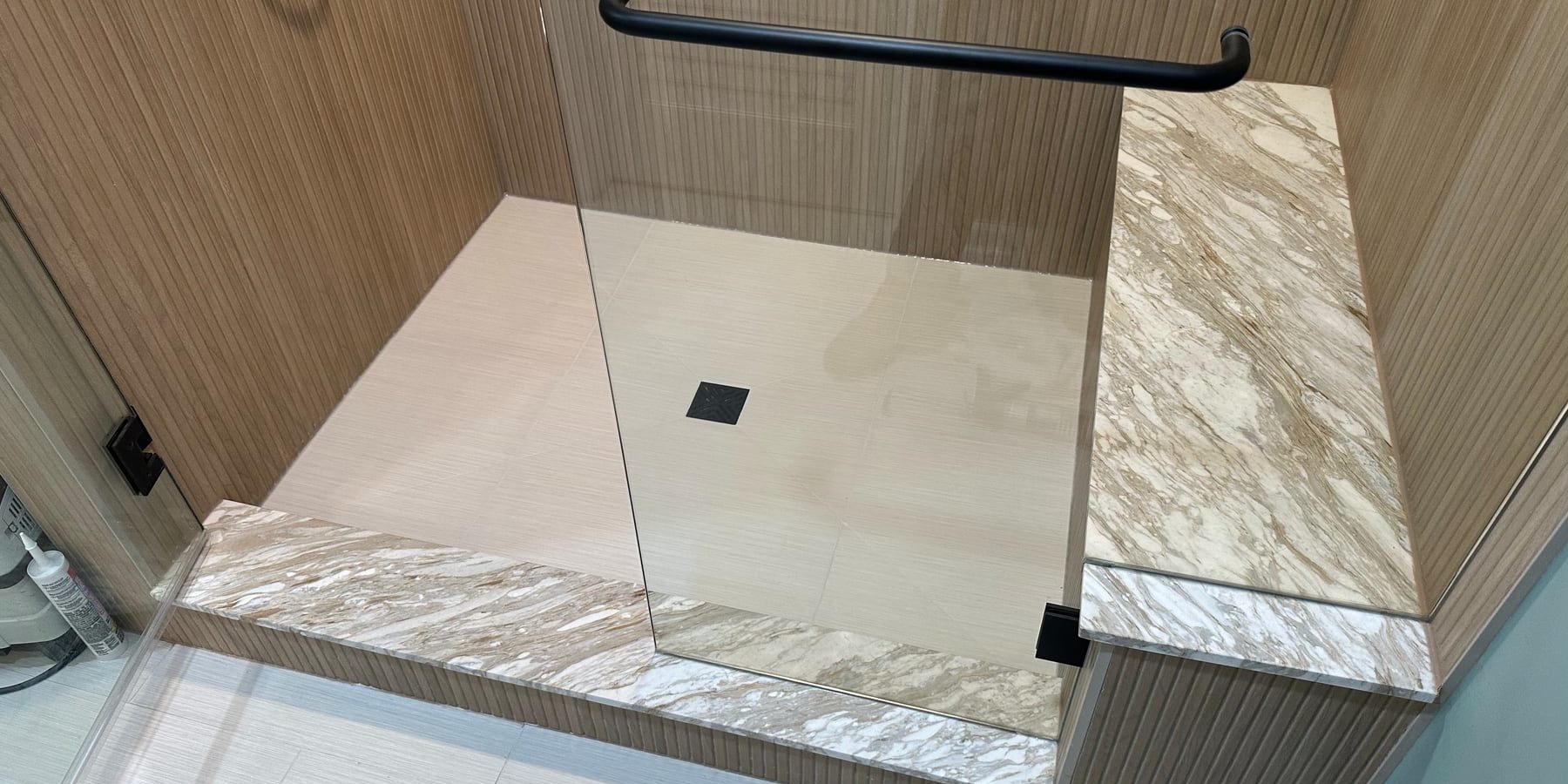
Documented North Shore Proof, Accurately Located in Highland Park
A documented 4NST project in Highland Park shows why the pattern matters. Extensive cracking crossed a penny-round shower floor. Removal confirmed that the substrate had been structurally compromised, so another surface patch would not have restored reliable support. The floor was rebuilt while the surrounding wall tile, stone surfaces, and glass enclosure were preserved.
That project occurred in Highland Park. It is regional proof of the diagnostic and preservation method, not a claim that the work happened in every community named on this page. See the complete Highland Park failed shower-floor case study.
Choose the Most Useful North Shore Local Page
The links below are grouped by the homeowner decision each completed page helps explain. They are not separate 4NST offices, and the short summaries do not diagnose a shower remotely.
Floor, curb, base, or lower-perimeter symptoms
- Glencoe shower repair explains why a curb-corner symptom should be evaluated with the enclosure, transitions, and tiled assembly.
- Glenview shower repair organizes shower-base symptoms by where and when water appears.
- Northfield shower repair focuses on whether a floor, curb, perimeter, or joint condition can be isolated before finishes are disturbed.
Recurring cracks, movement, loose tile, or a prior repair that failed
- Deerfield shower repair uses the outcome of previous caulk, grout, sealer, or tile work as evidence for the next evaluation.
- Riverwoods shower repair maps crack direction, movement, moisture timing, and prior repairs to distinguish a local defect from a connected failure.
- Winnetka shower repair addresses loose shower-floor tile and the difference between surface failure and deeper movement.
Preservation-sensitive repair boundaries
- Lake Forest shower repair explains how tile, stone, substrate, and waterproofing are evaluated before sound finishes are sacrificed.
- Kenilworth shower repair treats preservation as a boundary to be proved rather than promised before opening the assembly.
- Wilmette shower repair covers leaking and failed showers where repair scope should follow the evidence instead of a preset package.
Complex histories or an uncertain source
- Evanston shower repair helps organize symptoms where earlier renovations, building conditions, or several systems may overlap.
- Northbrook shower repair provides broad leak-and-failure triage and the steps to take before an inspection.
- Highland Park shower repair is the local service route for Highland Park; the separate case study above documents one specific completed repair.
For every current Chicago and North Shore location, use the complete 4NST service-area directory. This regional guide groups a selected North Shore cluster by diagnostic need; the directory remains the authoritative coverage list.
Send a Useful Shower Record
A useful first message does not need technical terminology. Send observable facts:
- one photograph of the full shower and closer views of the floor, drain, curb, lower corners, glass line, and reported damage;
- when the symptom first appeared and whether it is changing;
- what activates it and how long it takes to appear;
- whether any tile clicks, deflects, sounds hollow, loosens, or repeatedly separates;
- every prior grout, caulk, sealer, glass, plumbing, or tile repair and what changed afterward;
- whether water reaches another room, ceiling, wall, cabinet, or floor;
- the tile, stone, glass, trim, or nearby finishes you hope to preserve; and
- your North Shore community so the request can be matched to the correct local service route.
Do not remove tile, fresh caulk, or another prior repair merely to prepare for the conversation. Its location and condition may preserve useful evidence. If moisture appears independently of shower use or suggests a pressurized plumbing source, contact a licensed plumber or the appropriate professional.
Owner-Operated From Diagnosis Through Repair
North Shore Tile & Shower Repair is based in Morton Grove and has served Chicago and the North Shore since 1982. “North Shore” describes the service region; it is not a second storefront or a collection of satellite offices.
Kristopher Duschen is the owner and lead specialist. He reviews the history, evaluates the repair boundary, explains the trade and scope questions, and remains directly involved when 4NST performs the tile-shower repair. The inquiry is not sold by one person and handed to a subcontracted tile-repair crew.
Learn more about the owner-operated company and review the documented 4NST project gallery.
Frequently Asked Questions
What North Shore tile-shower problems does 4NST evaluate?
4NST evaluates leaks activated by shower use, recurring cracks, loose or moving tile, failed floor, curb and perimeter conditions, and prior surface repairs that did not hold. Kristopher first determines whether the likely source belongs to the tiled wet-area assembly, the enclosure, or another trade before recommending a scope.
Is a leak at a shower curb or corner always a caulk problem?
No. Worn sealant can be the problem, but the same wet location can also reflect spray escape, movement, improper slope, a waterproofing transition, a curb connection, or water traveling from elsewhere. The location where water appears is evidence, not automatic proof of the concealed source.
What does a crack that returns after regrouting prove?
It proves that the surface repair did not end the behavior; it does not prove which concealed component is responsible. Crack direction, nearby movement, the drain and curb relationship, moisture timing, substrate support, bond, and waterproofing connections must be evaluated before choosing another repair.
Can only the failed section be repaired instead of rebuilding the whole shower?
Sometimes. A focused repair needs a bounded failure, workable access, stable material around the opening, and a reliable place to connect new support and waterproofing. When movement, deterioration, or water-control defects continue beyond that boundary, a connected portion or the shower assembly may require broader reconstruction.
When should a plumber investigate instead of a tile-shower specialist?
Call a licensed plumber or the appropriate professional when moisture appears while the shower is idle, a pressurized supply or fixture is suspected, or the problem involves blockage, a trap, or plumbing drainage. Symptoms activated by shower use and centered on the tile floor, curb, perimeter, waterproofing, or drain interface fit a tile-assembly evaluation. Some conditions require both disciplines.
Will owner Kristopher Duschen personally evaluate a North Shore shower?
Yes. Kristopher reviews the symptom history, evaluates the shower and repair boundary, explains the recommended scope, and remains directly involved when North Shore Tile & Shower Repair performs the work. Tile-shower repairs are not transferred to a subcontracted crew after the initial conversation.
Start With the Evidence and the Correct Local Route
If your shower is leaking, cracking, moving, or repeating a failed repair, preserve the evidence and choose the most relevant local page above. If the source or page is unclear, send the photos, symptom timing, previous work, and finishes that matter.
Call 847-446-2029 or request an owner-led shower inspection.