
Leaking & Failed Tile Shower Repair in River North, Chicago
In a River North condominium, the wet spot and the failed detail may be separated by a wall, a floor, and several minutes. A damp curb after the shower stops tells a different story from water that shows up as soon as spray reaches the door. A ceiling mark below is an exit location, not a diagnosis.
North Shore Tile & Shower Repair concentrates on that sequence. Owner Kristopher Duschen evaluates the clues himself: activation time, spray direction, drain behavior, movement, and the route between the enclosure and the reported damage. He stays directly involved if the evidence leads to tile-assembly work. The objective is to correct a defined failure without sacrificing stable finishes—or to say plainly when the connected damage makes a narrow repair unsound.
Explore 4NST's tile and shower repair services or send the symptom details for an owner-led inspection.
Start With the Clock, Not the Stain
The most useful first fact is often when moisture appears relative to shower use.
At first spray: Water showing almost immediately when spray reaches the door, jamb, or top of the curb can favor a containment route near that location. It still needs confirmation; the first drip is not a repair prescription.
After sustained use: A symptom that takes several minutes to develop can reflect water accumulating around the floor, perimeter, drain field, or another concealed route.
After shutoff: Moisture emerging after the valve is closed may already be traveling through materials or along a connection before it reaches the visible outlet.
While the shower is idle: A new symptom with no recent shower use changes the investigation. Supply piping, a fixture, shared drainage, or another non-tile source may need attention from a licensed plumber or the appropriate building professional.
Timing narrows the possibilities; it does not name the failed component on its own. If water is actively reaching another finished space, discontinue shower use and photograph the result instead of running repeated experiments.
Read the Lower Shower as Three Routes
Route 1: door line, jamb, and curb
The curb has several interfaces packed into a small area: shower-side tile, curb top, outside face, glass or door hardware, jambs, and the bathroom floor. Moisture at its exterior can begin with spray escaping the enclosure, movement at a joint, a fastener or penetration, or a concealed curb connection. Calling every wet curb a failed pan skips the investigation.
Route 2: wall-to-floor perimeter
Corners and changes of plane must tolerate normal differential movement while remaining part of the water-control strategy. Repeated separation, a darkened edge, or a line that never seems to dry may be surface maintenance—or the visible outlet of moisture arriving from elsewhere. The surrounding tile's stability and the timing of the symptom help tell those situations apart.
Route 3: floor and drain field
The floor must support the tile, direct water, and meet the drain as a compatible assembly. Cracks radiating near the drain, pieces that click underfoot, recurring joint failure, or persistently wet areas shift attention toward support, slope, bond, and the drain-to-waterproofing connection. A simple clog belongs to a drain specialist; a defect in the tiled floor assembly is different work.
These routes meet one another. Repairing the most obvious exposed joint can change where water exits without correcting how it entered or traveled.
In a High-Rise, the Reported Location May Be One Floor Removed
A neighbor's ceiling stain can be the first alert even when the entry point is at a curb, penetration, drain connection, enclosure detail, or plumbing component. Concealed surfaces can carry moisture sideways before gravity makes it visible. The location below should therefore be paired with the usage timeline and conditions inside the shower.
The owner or authorized contact must determine the property's notification, access, insurance, protection, and approval rules. 4NST does not represent this page as a promise to coordinate with an association, management company, carrier, or adjacent unit.
Draw a Firm Line Between Tile Work and Plumbing Work
4NST's lane is the tiled wet-area assembly: finish material, bond, support, slope, waterproofing, drain interface, curb, and perimeter connections. The inspection asks whether those elements explain the observed sequence.
A pressurized pipe leak, shared stack issue, blockage, fixture defect, or moisture unrelated to shower use can sit outside that lane. When the facts point there, a licensed plumber or other appropriate professional is the correct resource. Defining that boundary early protects the homeowner from paying for tile work that cannot solve the reported problem.
Treat a Repaired Joint as a Diagnostic Experiment
Grout and flexible sealant are useful materials when the joint itself is the defect. Their performance after a prior repair also supplies evidence. If fresh material opens along the same line, if the wet area relocates, or if the interval before leakage changes, the assembly is showing that another force or route may be involved.
A surface application cannot add support beneath a flexing floor, remake a buried waterproofing turn, alter incorrect slope, or reconnect a drain flange. Conversely, an isolated worn seal should not be inflated into a full shower failure without evidence. The important question is whether the prior treatment resolved the activation pattern or merely changed its appearance.
Crack Geometry Changes the Priority
One chipped joint and a repeating line across several pieces are not equivalent. Kristopher looks at where a crack begins, what it crosses, whether it returns, and whether nearby material moves or sounds different.
A line radiating from the drain can redirect attention toward that floor field. A split that follows the curb or a plane change can raise questions about support and movement accommodation. Multiple loose pieces alongside delayed dampness carry more weight than a dry hairline crack by itself. These patterns can justify a controlled opening, but none of them proves a specific concealed defect before the area is examined.
What the Owner-Led Evaluation Tries to Disprove
Kristopher does not begin with a demolition size. He works through competing explanations and tries to eliminate the ones that do not fit.
- An enclosure-only escape: Does the problem occur only when spray reaches one door edge or glass connection?
- An isolated maintenance joint: Is the surrounding assembly motionless and dry, with a clearly limited seal failure?
- A plumbing source: Can moisture occur while the tiled shower is idle, or do the symptoms follow a fixture, supply, or drain condition?
- A localized assembly fault: Can the curb, perimeter, drain field, or one floor section account for the complete pattern?
- A connected failure: Do movement and moisture cross boundaries that a small opening could not reconnect dependably?
The same owner who considers those questions remains directly engaged if 4NST performs the tile-shower work; it is not passed from a sales visit to a subcontracted repair crew. Read about the owner-operated company and browse the documented 4NST project gallery.
A Partial Repair Must Pass Three Gates
A limited opening is technically realistic only when all three answers are favorable.
Can the fault be isolated? The observations must point to a bounded portion of the shower rather than a pattern of movement or moisture crossing several components.
Can that portion be reached? Glass, stone, trim, and adjacent tile affect access. A theoretically small defect is not a small repair if reaching it destroys the connection needed for the replacement work.
Can the new work join what stays? Support and waterproofing need a sound termination. A patch that ends against unstable backing, an unusable drain connection, or deteriorated material does not pass this gate.
When all three gates pass, work may be limited to a curb, drain field, floor zone, threshold, or lower-perimeter section. When one fails—because movement is widespread, concealed material is degraded, or no trustworthy connection can be made—the shower may require a larger rebuild. The building type and finish price do not decide this; continuity of the assembly does.
Create a Finish Inventory Before Opening Anything
Preservation works best as a documented constraint rather than a blanket promise. Before access is chosen, identify the elements that matter: a stone curb cap, matched wall tile, a slab bench, frameless glass, or surrounding bathroom finishes. Then assess how each relates to the suspected route.
Some components may stay untouched. Others may need careful removal to reach the curb, floor, drain, or waterproofing. Natural stone and older tile can vary enough that an exact match is unavailable; glass may need handling outside 4NST's scope. The plan should disclose those risks before work begins and never depend on exposed caulk as the sole connection between old and new water-management work.
Relevant Proof, Correctly Located in Highland Park
One completed 4NST repair shows why the support beneath the finish matters. In Highland Park, a penny-round floor had extensive cracking and the substrate was structurally compromised. The failed floor was taken out and rebuilt; the surrounding wall tile, stone, and glass enclosure were retained.
That evidence belongs to Highland Park and is not presented as River North work. Its relevance here is the method: use the crack field to investigate the support, set a repair limit around verified failure, and protect unaffected materials.
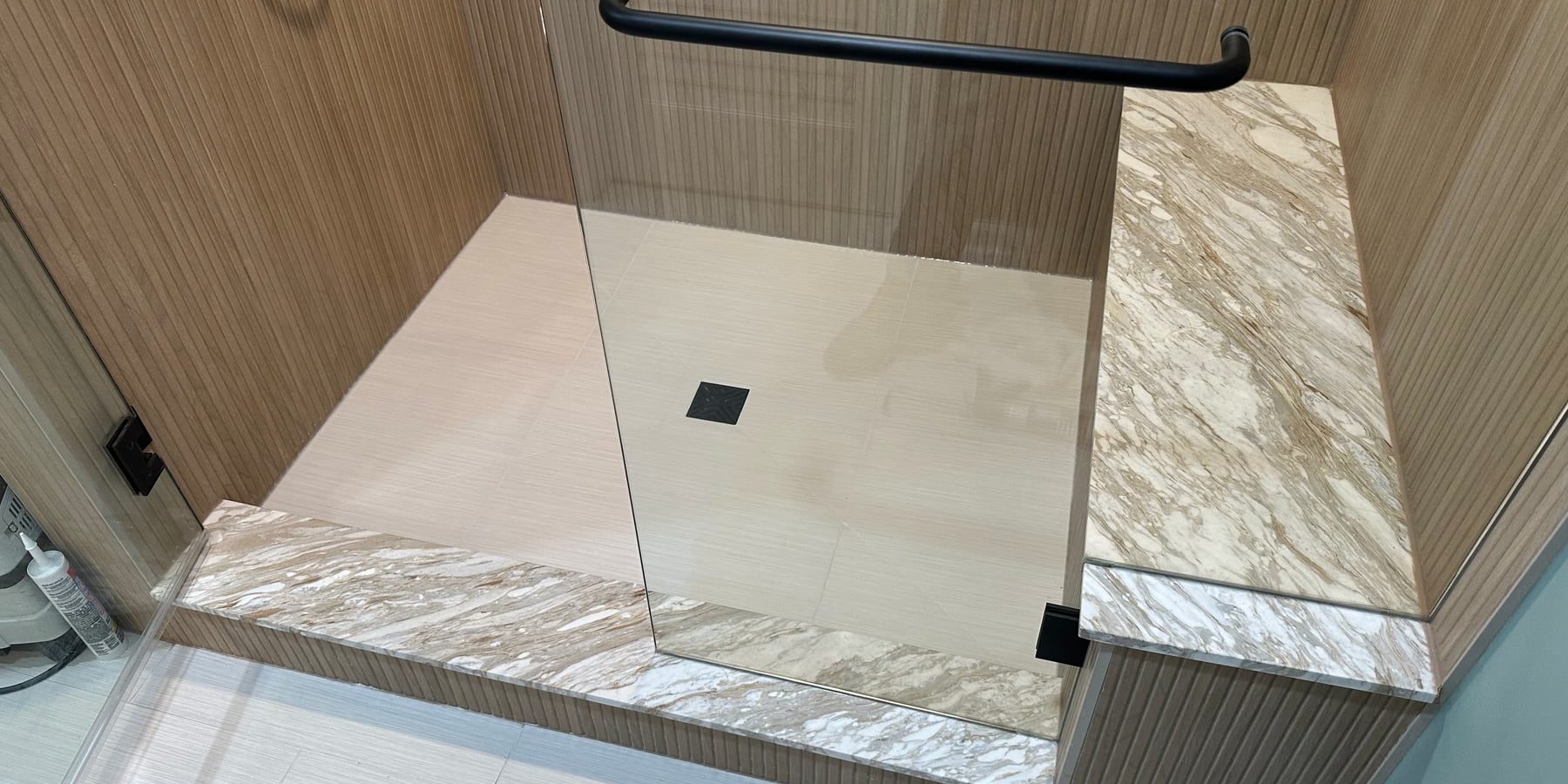
Open the full Highland Park failed shower-floor case study.
Make a 60-Second Incident Record Before Calling
A short record is more useful than a guess about the cause. Capture one wide photograph of the enclosure; close views of the drain, floor edges, curb, jambs, and reported damage; and any staining in the room or ceiling below. Note the following in plain language:
- Shower start time and the minute the symptom became visible
- Whether it grew after the valve was shut
- The spray direction immediately before it appeared
- Any clicking, deflection, recurring split, or slow-drying area
- What changed after earlier grout, caulk, glass, sealer, or plumbing work
- Which stone, tile, glass, and adjoining finishes need special protection
- Whether matching material is already available
Leave the assembly undisturbed for the initial conversation. Removing a tile or opening a ceiling can erase useful clues and is not required merely to request an inspection.
Why the 4NST Model Fits Diagnostic Shower Work
4NST has served Chicago and the North Shore since 1982, but longevity is not a substitute for a specific explanation. The practical distinction is continuity: Kristopher hears the symptom history, evaluates the failure route, develops the scope, and stays involved in the tile work. A repair is not handed from an estimator to an unknown subcontracted crew.
That continuity helps when the answer is conditional. The owner can explain why a drain zone may be separable, why a curb cannot be trusted, why a plumber should enter first, or why saving a finish would leave the water-control system incomplete.
4NST is based in Morton Grove and serves River North along with other Chicago and North Shore communities. Check the current Chicago and North Shore service territory.
Frequently Asked Questions
What does a delayed leak reveal about a River North tile shower?
It establishes a timeline, not a source. Moisture that emerges after several minutes or after shutoff may have accumulated or traveled before reaching the visible outlet. Combine that delay with spray direction, drain behavior, floor movement, crack location, and prior repair history before deciding which component deserves access.
If water reaches the ceiling below, should I run the shower again to test it?
No repeated testing is advisable while active water is reaching another finished space. Stop using the shower, photograph the affected locations, write down the usage-to-symptom interval, and follow any building notification requirements. A ceiling mark alone cannot distinguish a tile-assembly route from enclosure or plumbing causes.
Can exterior curb moisture originate somewhere other than the pan?
Yes. Spray escape at the door, a jamb or fastener, the curb top, a wall connection, and plumbing are among the routes that can produce moisture at the curb's outside face. Its start time and response to spray direction help organize the investigation; the wet location by itself does not prove pan failure.
When is a partial tile-shower repair technically realistic?
A partial scope needs three things: an isolated fault, workable access, and a sound place to join the new support and waterproofing to what remains. If movement, deterioration, or moisture crosses those limits, a larger shower reconstruction may be necessary even when some finishes still look intact.
Should a plumber or a tile-shower specialist investigate first?
Symptoms independent of shower use, pressurized piping leaks, blockages, and shared drainage concerns point toward a licensed plumber or the appropriate building professional. Problems activated by spray or shower use and centered on the tiled floor, curb, perimeter, waterproofing, or drain interface fit a tile-assembly evaluation. Some cases require both disciplines.
Will Kristopher personally evaluate my River North shower?
Yes. Kristopher Duschen is the owner and lead specialist; he evaluates the symptom pattern and stays directly involved when 4NST performs the tile-shower repair. The work is not transferred to a subcontracted tile-repair crew after the initial conversation.
Build the First River North Diagnostic Record
If the problem involves a damp curb, a delayed drip, recurring floor cracks, or water outside the bathroom, start by preserving the timeline rather than applying another surface product.
Call 847-446-2029 or send photographs and request a professional shower inspection. Include the activation time, exit location, spray direction, prior attempts, and the finishes that matter most.
4NST is based in Morton Grove and serves River North, Chicago, and the North Shore.